With the cooler weather this week, stream flows have dropped. Currently, Vail Mountain has close to 30 inches of snow water equivalent still sitting up top. The average this time of year since 1979 is close to 20 inches. We are just hoping it takes its time melting off.
Streams and rivers are measured in cubic feet per second. All bodies of moving water vary in size and flow. CFS readings are different for each body of water, for example, when the Gore is running at 1000 cfs, that is considered high. However, downstream in the Eagle River, 1000 cfs is a much calmer flow because the river is larger and can handle more water.
The USGS has a few detailed web pages on how rivers and streams are measured. It is an interesting process that interpretes data for all creek managers and those who use the creek for recreation.
This week the Gore almost reached 270 cfs and we noticed a rafting company taking a trial run. Unfortunately they did not make it too far. Today we are at 176 cfs and when the sun comes out, plan on that number jumping up significantly.
When the Gore reaches 350 cfs you will certainly start to notice more activity on the Gore. Mountainbuzz.com is a good website for kayakers and the local gauge from the USGS.
Saturday, May 21, 2011
Friday, May 20, 2011
USGA Green Section Report
Derf Soller is a Northwest Agronomist for the USGA. Formerly the Superintendent at Breckenridge Golf Club, Derf is quite familiar with mountain golf course maintenance. He has been on the prowl checking out courses as they emerge from the white stuff. Click here to read his latest update on courses that have been affected by the amount of snow this winter and critical tips on preparing the course for the summer.
Vail Golf Club has been able to aerify greens already, however aerifying tees and spiking fairways remain. We are looking forward to drier weather to accomplish these practices. We will most likely have to balance play and cultural practices.
Thursday, May 19, 2011
Assistant's View: The New Kid
It has been nearly a month since I have started my new position as an assistant superintendent to Mr. Steve Sarro at Vail Golf Club. Moving from Iowa in April, I was told that I would have two springs this year but had no idea that I would be watching snow fall towards the end of May. I think it is pretty cool but I am as excited to get this season in “full swing” as everyone else.
A few things I have experienced here include: training new staff, clearing greens of snow, sand bagging the Gore Creek, and how quickly the weather changes in a moment’s notice. Having most of my work experience in the Midwest, mountain golf course maintenance will be a new concept I am excited to learn. I am interested in the different types of plants and animals, climatic changes, agronomic principles, and the lack of turf pests and disease pressures.
So far, everyone I have met that works for Vail Recreation District (VRD) is very nice, supportive and up-holds a team player attitude. The VRD provides an excellent working environment and I look forward to becoming more involved in all aspects of the organization.
Hope to see you on the course soon,
Andy Unrau
A few things I have experienced here include: training new staff, clearing greens of snow, sand bagging the Gore Creek, and how quickly the weather changes in a moment’s notice. Having most of my work experience in the Midwest, mountain golf course maintenance will be a new concept I am excited to learn. I am interested in the different types of plants and animals, climatic changes, agronomic principles, and the lack of turf pests and disease pressures.
So far, everyone I have met that works for Vail Recreation District (VRD) is very nice, supportive and up-holds a team player attitude. The VRD provides an excellent working environment and I look forward to becoming more involved in all aspects of the organization.
Hope to see you on the course soon,
Andy Unrau
Wednesday, May 18, 2011
Questions
As a golf course superintendent I am used to questions. They come in every shape and form and from everyone, I mean everyone. Some questions are good, others not so much, but I deal with them. A large part of my job is education, I get it, you want to play and I need you to play, so I am glad to help whenever I can.
So what is going on out there?
Good Question! Lots actually. Let me preface this by saying that all of these projects are way overdue and are products of deferred maintenance. We are not only correcting safety issues on all of these projects and but we are setting a new standard for Vail Golf Club.
We also have finishing touches on a new lightning shelter near the 11th green, new cart path to replace on 11, a new potential net going up at the 5th tee, plenty of clean up and of course more sand bagging on the course.
When will these areas be open for play?
Bad Question! Time lines on all of these areas depend on weather right now and we are doing everything possible to speed up the process. We will however have some golf available real soon. Keep it here, our facebook page and http://www.vailgolfclub.net/ for the latest on course openings. Get busy with the sun dance!
Preparations
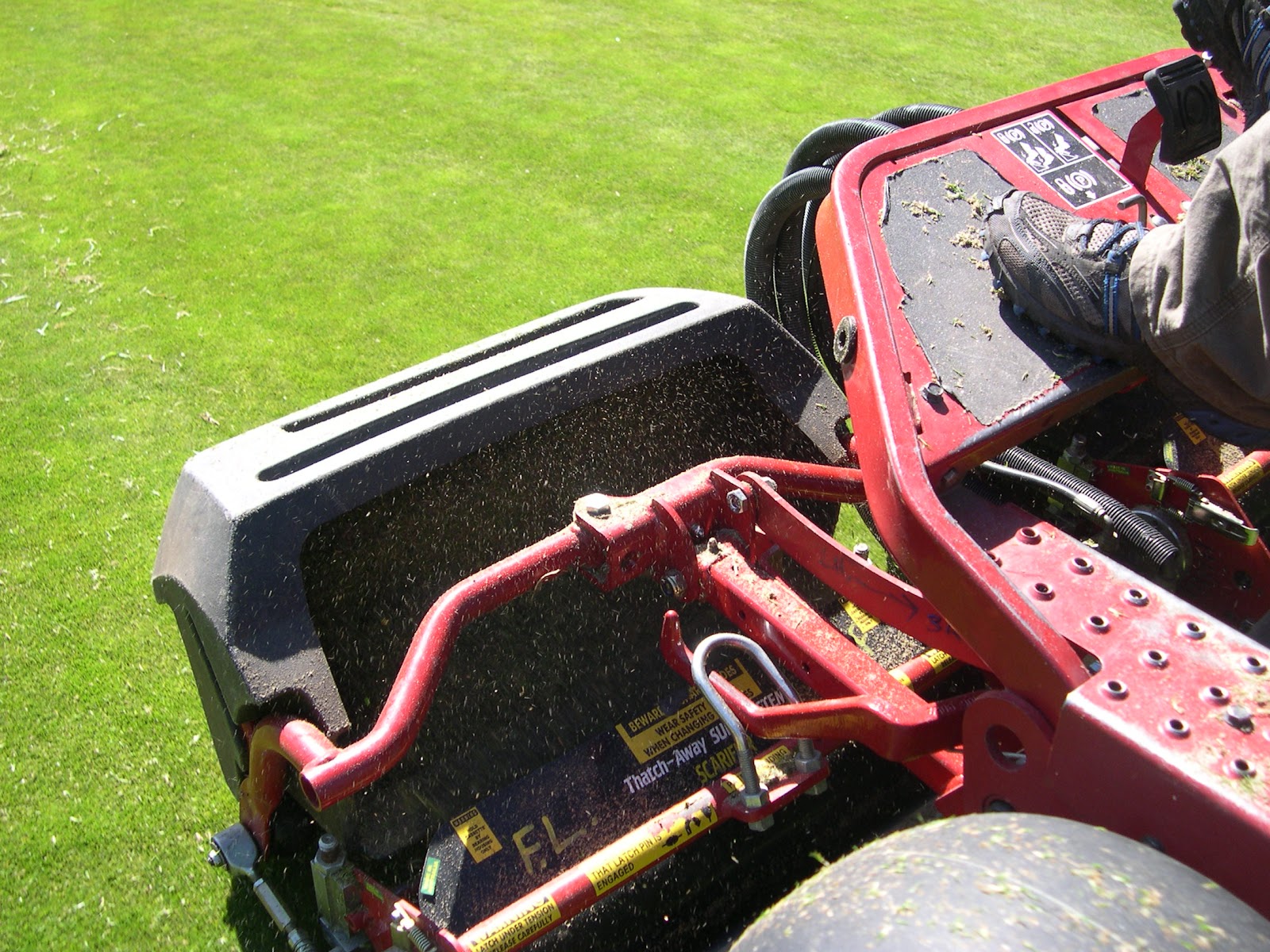
Each spring, before the golf season begins, we prepare the greens for a grueling summer of more than 24,000 rounds of golf and all of the other environmental stresses of a golf season. If you have been paying any attention to this blog, you know how much thatch in the putting greens can be a problem. During the shoulder seasons we take advantage of the down time to get aggressive on removing thatch.
A few years ago I purchased some scarifying reels. They are deep vertical blades that help remove some of that organic matter in the soil profile. It is less invasive than pulling aerification cores and is easier with less labor to accomplish. In no way does scarifying replace core aerification, but it helps.
After pulling out some material, we run the aerifiers out on all the greens with solid tines to spike and vent the greens. Every 2 inches there is a 5/8" hole that allows the soil the breathe from a long cold hard winter.
We finally add sand topdressing and drag them into the holes. The sand has multiple benefits such as diluting thatch, creating a firmer surface, smoothing out the surface, helping ball marks and promoting growth. Once a part of the soil profile, the sand eases compaction rates from traffic, allows for better air, water and nutrient movement.
The recent weather has slowed us down with accomplishing all of these tasks, but we hope to finish this all be the end of the week. Keep your fingers crossed.
A few years ago I purchased some scarifying reels. They are deep vertical blades that help remove some of that organic matter in the soil profile. It is less invasive than pulling aerification cores and is easier with less labor to accomplish. In no way does scarifying replace core aerification, but it helps.
After pulling out some material, we run the aerifiers out on all the greens with solid tines to spike and vent the greens. Every 2 inches there is a 5/8" hole that allows the soil the breathe from a long cold hard winter.
We finally add sand topdressing and drag them into the holes. The sand has multiple benefits such as diluting thatch, creating a firmer surface, smoothing out the surface, helping ball marks and promoting growth. Once a part of the soil profile, the sand eases compaction rates from traffic, allows for better air, water and nutrient movement.
The recent weather has slowed us down with accomplishing all of these tasks, but we hope to finish this all be the end of the week. Keep your fingers crossed.
Sunday, May 15, 2011
River Restoration
As a member of the Eagle River Watershed Council I make a point to volunteer for many of their projects each year. More importantly I learn something new each time and meet some great people in this valley.
Yesterday a team of seven planted willow cuttings along the Eagle River in Edwards. Over the past couple of years, The Council has taken the lead with numerous sponsors and donors to restore eroded banks of the Eagle River.
Improvements include restoring river banks, creating boat ramps, assisting with the speed of flows in the creek and overall providing a better habitat for fish and riparian wildlife.
The banks in this area looked more like cliffs and the creek was getting wider from erosion. That type of destruction does not allow plants to thrive or create healthy waters for fish and boating. Plants help stabilize banks, shades water to prevent temperatures from getting to high and can also provide food and shelter for riparian critters.
Today, Thanks to B&B Excavating the banks are graded out and seeded. The Watershed Council has gathered willow cuttings and over the past few weeks have been propagating them into the river bank. Thousands of cuttings have been planted. Willows are excellent species for creek banks, they are very hardy plants that thrive on wet soils. The success rate of all these cuttings is about 70%.
The project is nearing completion. You can get a better look at everything that has been done or yet to be done in Edwards this coming week. Visit http://www.erwc.org/ to sign up for out River Float this Friday afternoon. River guides are from the US Women's and Men's White Water Rafting Teams!
As we develop our river restoration plan on the Gore through Vail Golf Club, I see us doing some of the same practices. It is a cheap and very effective way of restoring a natural habitat.
Yesterday a team of seven planted willow cuttings along the Eagle River in Edwards. Over the past couple of years, The Council has taken the lead with numerous sponsors and donors to restore eroded banks of the Eagle River.
Improvements include restoring river banks, creating boat ramps, assisting with the speed of flows in the creek and overall providing a better habitat for fish and riparian wildlife.
The banks in this area looked more like cliffs and the creek was getting wider from erosion. That type of destruction does not allow plants to thrive or create healthy waters for fish and boating. Plants help stabilize banks, shades water to prevent temperatures from getting to high and can also provide food and shelter for riparian critters.
Today, Thanks to B&B Excavating the banks are graded out and seeded. The Watershed Council has gathered willow cuttings and over the past few weeks have been propagating them into the river bank. Thousands of cuttings have been planted. Willows are excellent species for creek banks, they are very hardy plants that thrive on wet soils. The success rate of all these cuttings is about 70%.
The project is nearing completion. You can get a better look at everything that has been done or yet to be done in Edwards this coming week. Visit http://www.erwc.org/ to sign up for out River Float this Friday afternoon. River guides are from the US Women's and Men's White Water Rafting Teams!
As we develop our river restoration plan on the Gore through Vail Golf Club, I see us doing some of the same practices. It is a cheap and very effective way of restoring a natural habitat.
Tuesday, May 10, 2011
Pouring Concrete
As I mentioned in the previous post, today was a productive day. Concrete was finally poured onto the new bridges on #11 and #17.
It will take a few days for the concrete to cure and be ready to access. This week we will be organizing cart path work to be completed to tie in the new bridges to the existing cart paths.
Before the end of the day, the concrete crew was putting on the finishing touches.
Subscribe to:
Posts (Atom)